You Can’t Keep a Good Man Down
H is for HawkYou Can’t Keep a Good Man Down is a satirical novel in which T. H. White sends Dr Prisonface, a failed schoolmaster, through a sequence of social humiliations and declining fortunes. The book attacks the educational system and the cult of the English Gentleman, but its force is also personal: White uses Prisonface’s downfall to put his former life on trial, then imagines a future self who can look back on that failure with pity rather than contempt. The novel’s movement from relentless mockery to a more humane final speech makes it both an exercise in self-punishment and an attempt at release.
Composition and purpose
White works on the novel in the evenings by the light of an Aladdin lamp, after leaving his former life behind. It is a work begun while he was at Stowe, and by this point it is nearly finished. The act of writing is described as doing his old life to death: the story does not simply invent an unfortunate protagonist but subjects a recognizable version of White’s past to an ordeal of failure, exposure, and ridicule. That self-directed quality gives the satire a double edge. Its attacks on institutions are also bound up with the author’s effort to separate himself from the role he once occupied within them.
The book’s central target is the public-school headmaster and the social ideal attached to him. Prisonface is terrified of life and exists through other people’s regard, like a chameleon or a mirror. This dependence makes him an apt figure for a culture that prizes the performance of authority and gentlemanly identity: he appears to have a self only insofar as others reflect one back to him. The novel’s satire therefore concerns more than a failed individual. It exposes the fragility of a status built on approval, convention, and the supposed authority to educate others.
Prisonface’s decline
Prisonface loses his position at a school and then moves through a succession of unsuccessful roles and encounters. He tries to become a private tutor, a farmworker, and a beggar, but each attempt fails. The downward course is deliberately repetitive: rather than allowing him to recover his former authority in a new setting, the narrative makes each change of occupation another occasion for others to explain his uselessness and unreality. Even the narrator joins in, repeatedly adding to the pressure against him. The protagonist is thus not protected by the voice telling his story; narration itself becomes part of the machinery of humiliation.
The episodes extend the satire across several versions of English and public life. Prisonface courts a dark-haired, boyish barmaid and is rejected, then retreats from the attention of her mother. He flies with drunken aviators descended from Romantic poets, and later tries to instruct Hollywood moguls in the conduct of Gentlemen. That attempt ends in humiliation when they shoot grouse with tommy guns. The variety of these encounters gives the novel an episodic, picaresque shape: Prisonface travels through different social worlds, but none offers him a stable identity or a successful escape from judgment. The repeated reversals make his fall comic in form while keeping its psychological stakes severe.
The country-road encounter
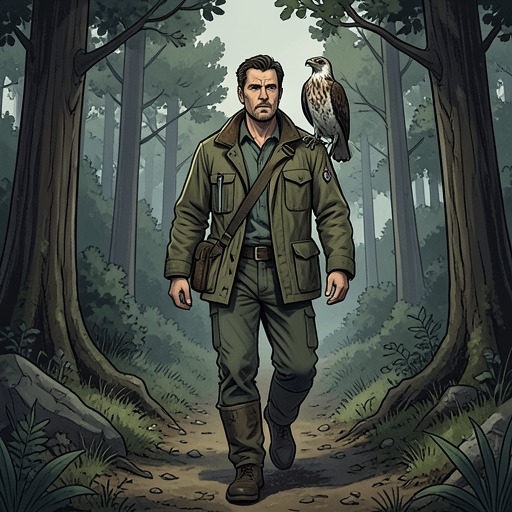
Near the end, homeless and limping, Prisonface meets a mysterious man on a country road. The stranger is accompanied by a black dog and carries himself with a confidence that draws Prisonface toward him. He represents a possible alternative to the protagonist’s dependence and defeat: once a schoolmaster himself, he left because he could not bear the people teaching there, and now lives contentedly in a cottage in the woods. The novel makes the resemblance between this figure and White’s imagined future self explicit. He is not merely another stranger in Prisonface’s downward passage but a picture of what White hopes to become after leaving his former role.
The stranger’s extended criticism of the school system turns the encounter into an argument about how people are formed. He contrasts the patience required to train a goshawk with the idea that a human being’s complex psychology can be taught by force. The point connects the novel’s social satire to White’s experience of hawk training: disciplined attention and an understanding of the creature stand against the presumption that people can be shaped through a crude instrument of authority. In the encounter, the man’s independence and contentment also challenge Prisonface’s assumption that power and certainty must come from conventional status.
The final speech and its significance
As White writes the exchange, the tone changes. The stranger speaks to Prisonface’s past in terms of a return to school in search of something still missing: safety, a talisman that would make it possible to leave, and finally perhaps love. The speech is identified as perhaps the least cruel and most humane in the novel. After a narrative that repeatedly mocks and diminishes its protagonist, it allows White to address his past self with compassion. The change does not erase the book’s satire; it reveals the need beneath its severity. Prisonface’s failures remain, but they are no longer the only terms on which he can be understood.
The novel does not resolve that tension by presenting its imagined future self as conventionally respectable. The stranger is described as wicked and free, cast out and content with his lot. His name, disclosed at the end of the episode, is Lucifer. The name joins rebellion and fall to the role of a light-bringer, giving the figure an unsettling authority outside the school and social order that the novel attacks. The ending therefore does not simply replace Prisonface’s failed identity with a secure new one. It imagines freedom as an exiled condition, and lets the final promise of compassion coexist with an identity defined by departure. In that contrast, You Can’t Keep a Good Man Down turns a comic, punishing descent into White’s attempt to imagine a life beyond the institution and beyond the self that institution had made.